


The Douglas Fir is a towering giant of the Pacific Northwest. Best known for its distinct cones, cork texture bark, and fragrant needles, this tree can reach heights of over 330 feet tall by maturity. This tree is a member of the Pinaceae family, the largest family of cone bearing trees, or conifers, alive today. These trees are evergreen, meaning they keep their foliage year round. This is in direct contrast to deciduous trees, which go dormant for the winter and generally drop their leaves in autumn. There are two kinds of Douglas Fir: Rocky Mountain and Coastal. Rocky Mountain Douglas Firs prefer mountainous regions, while Coastal ones prefer a moist environment. The Douglas Fir is not considered a true fir, as its cones hang down off the branches instead of standing straight out. Additionally, these cones drop off the trees, while true fir cones disintegrate.
Image by Walter Siegmund, Wiki Creative Commons
Foliage
The Douglas Fir has needles that stick out straight from and grow directly on each branch. These needles are soft, as opposed to spruce needles which can be pointy and sharp to the touch
Seeds or Cones
This cone is one of the easiest to identify out of all conifers in the Pacific Northwest using a simple trick. According to legend, a long time ago, a mouse was caught in a wildfire, desperately trying to find cover. First, it approached the maple, asking “will you keep me safe?” The maple replied “I am sorry, I am already catching fire myself, I cannot help you.” Next the mouse approached the cedar, once again asking “will you keep me safe?” The cedar replied “I am sorry, I have nowhere to keep you hidden.” Finally, the mouse ran to the Douglas Fir, pleading “please, I have nowhere else to go!” The Douglas Fir told the mouse to hop inside it’s cone. The mouse did, barely escaping the fire. To this day, you can still see the hind legs and tail of the mouse sticking out of the cones.

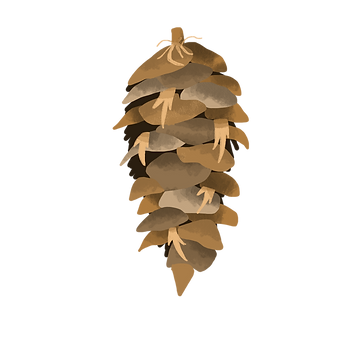
All illustrations by A.S. Longman
Did you know?
Douglas Firs can “self prune” their lower branches. If growing in a densely populated forest, the tree will rid itself of lower limbs and grow taller to reach patches of sunlight.

Download your own QR code here! On a phone, tap and hold to save. On a computer, right click. See the "make a sign" page for detailed instructions on how to make your own sign, and access additional tools!